
Customers Don't Care About Your Org Charts
Customers don't care if Creative reports into Marketing or if UX sits under Product. They don't care whether Merchandising owns assortment, Marketing owns promotions, Sales owns relationships, or Customer Service owns post-purchase support. They don't care who manages the website, who owns analytics, whether Customer Experience is its own department this year, or how many people need to be Responsible, Accountable, Consulted, and Informed before anything gets done. They care that buying from you is easy. That your website makes sense. That your emails are relevant. That your product solves the problem it promised to solve. That when they need help, someone actually helps them.
So here's the question I've been asking myself lately: if customers don't experience our organizations in silos, why do our processes, workflows, and operating models still revolve around them? Most companies are optimized around functions instead of customer outcomes. Marketing has its priorities. Creative has its requests. UX has its roadmap. Product has its sprints. Sales has its targets. Customer Service has its queue. Everyone is working hard, but often in parallel instead of together. Meanwhile, the customer experiences only one brand, one journey, and one outcome. Maybe it's time we stopped organizing around departments and started organizing around solving real customer problems.
Customer Experience Isn't a Department
One of the biggest mistakes organizations make is assuming customer experience belongs to one particular team. It doesn't. Customer experience isn't a department, a function, or a title. It's the cumulative result of hundreds of decisions made across Marketing, Creative, UX, Merchandising, Product, Engineering, Sales, Customer Service, Operations, and beyond. Every interaction either strengthens or weakens the customer's experience.
That's why great customer experiences are never created by one department. They're created when cross-functional teams come together around a shared customer outcome instead of optimizing their own piece of the puzzle. Marketing may attract the customer. UX may help them navigate. Merchandising may shape what they buy. Sales may build the relationship. Customer Service may solve a problem. But to the customer, it's all one experience. The organizations that recognize that—and organize around it—are the ones that win.
The Best Creative Happens Cross-Functionally
The most valuable creative teams help define the customer experience before the brief even exists. They're sitting beside UX researchers, marketers, merchandisers, product managers, customer service leaders, and customer insights teams asking better questions before anyone starts designing solutions.
Creative can shape perception. It can build excitement, create demand, and tell a compelling story. But no campaign, no matter how beautiful or persuasive, can overcome an experience that doesn't deliver on its promise. If the product disappoints, the website creates friction, inventory isn't available, shipping takes too long, or customer service falls short, the gap between what was promised and what was experienced only gets wider.
That's why the future of in-house creative isn't about making more assets—it's about helping shape better experiences. When Creative is invited into cross-functional conversations from the beginning, it helps ensure the story being told matches the experience customers will actually have. That's how brands build trust. Not by making bigger promises, but by making promises the entire organization is prepared to keep.
Build Workflows Around Customer Needs
Instead of organizing workflows around functions, imagine organizing them around customer needs. Instead of Marketing launching campaigns, Creative producing assets, UX improving usability, Product building features, Merchandising managing assortment, and Analytics reporting performance, bring those perspectives together around one shared mission: solve a real customer problem. A cross-functional pod might include leaders and specialists from Marketing, Creative, UX, Product, Merchandising, Engineering, Customer Service, and Analytics. Diverse expertise. One outcome.
Notice the mission isn't "launch the campaign," "design the assets," "redesign the page," or "increase email opens." Those are outputs. The mission is to make it easier for customers to discover the right product. To remove friction from checkout. To build confidence in a purchase. To simplify onboarding. To increase trust. When Marketing, Creative, UX, Product, and Customer Service are solving those challenges together from the beginning, every communication, every interaction, and every decision works toward the same customer outcome.
Customers don't experience channels, departments, or handoffs. They experience moments. The best organizations recognize that and build teams that reflect how customers actually experience the brand. Instead of passing work from one function to the next, they solve problems together from the start. That's where better customer experiences—and better business results—begin.
Enter the Customer Pod
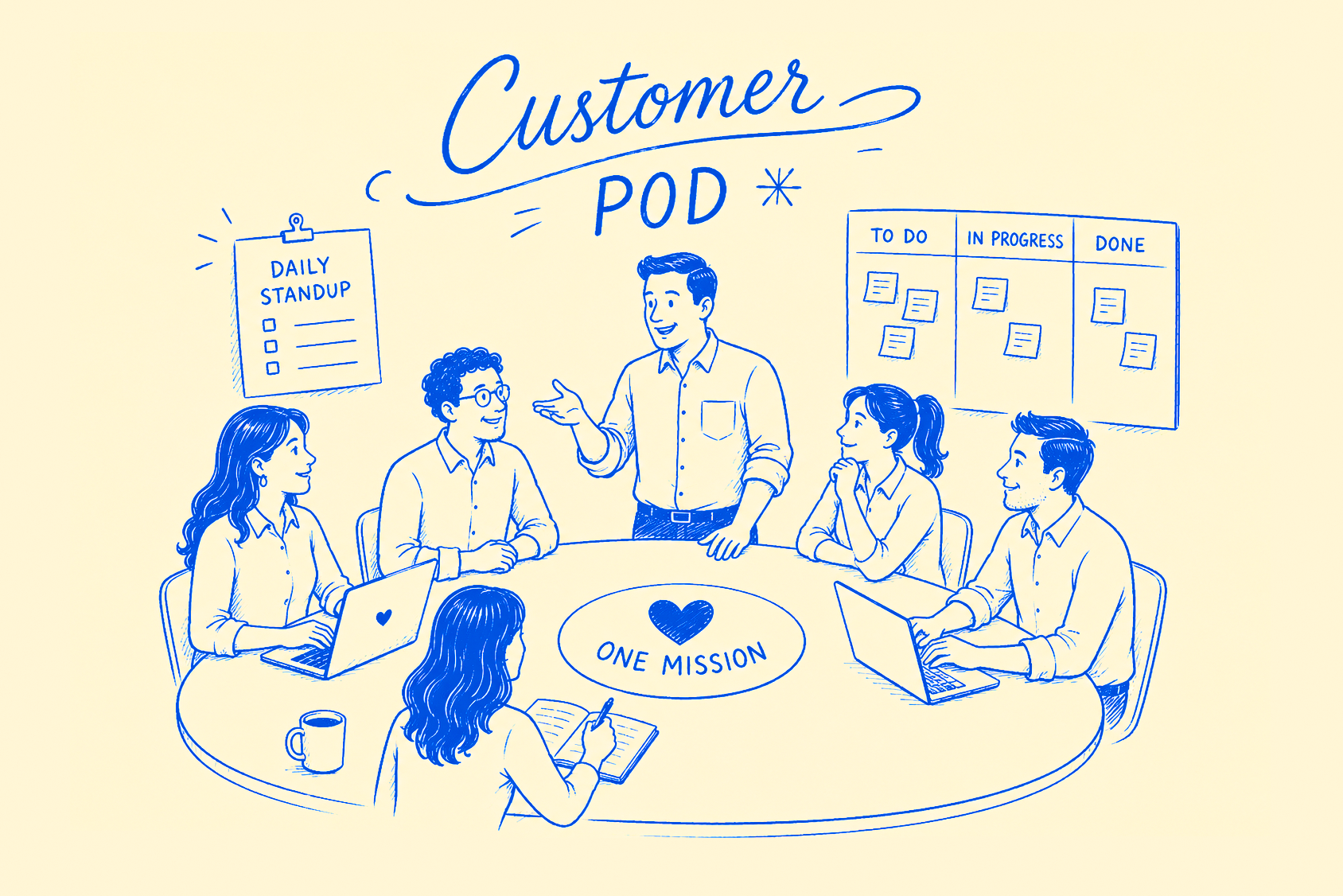
If customers don't experience your organization in departments, why are we still organizing work that way? Imagine replacing handoffs, approval chains, and siloed priorities with a small, cross-functional customer pod. Marketing, Creative, UX, Product, Merchandising, Engineering, Customer Service, and Data working together with one shared mission: solve a real customer problem. Not launch a campaign. Not redesign a page. Not hit an email metric. Just, solve the problem.
When the right people are in the room from the beginning, approvals shrink, handoffs disappear, decisions happen faster, and the work gets better because everyone who shapes the customer experience is solving it together. Functional leaders still develop their teams and disciplines, but the pod owns the customer problem. And that's the shift. Customers don't care about your org charts, your approval processes, or your RACI matrix. They care whether you made their lives better.
A Pod Needs One Way of Working
A customer pod is not another meeting, committee, or duplicate workflow. It is the workflow. A small, cross-functional team from Marketing, Creative, UX, Product, Merchandising, Engineering, Customer Service, and Data comes together around one mission: solve a real customer problem. The pod has one shared backlog, one cadence, and one way of working. Just as importantly, every pod has one leader. Without one, the pod quickly becomes a committee. The pod leader isn't another approver—they're the quarterback. They facilitate daily standups, align priorities, make decisions, remove roadblocks, maintain momentum, and ensure the team never loses sight of the customer outcome. Functional leaders continue developing their teams and disciplines, but the pod leader owns the work.
That doesn't mean the pod operates in isolation. Executives still receive regular shareouts. Functional leaders still provide coaching and expertise. And when the pod needs a blocker removed, the right leaders step in to help—not to create another approval gate. The pod commits to its rituals, trusts the people closest to the customer to make decisions, and keeps the work moving. That's what makes pods different. They're not another layer of process. They're the process.
The Real Competitive Advantage
Customers never experience your org chart. They experience the way your organization works. The companies that win won't have the best organizational structures. They'll have the best operating models.
